Thursday, June 30, 2016

HINDSIGHT


Hindsight

Hindsight is a great thing. Should have hunted that area, should have gone out for Fairy potatoes last week and the list goes on. I learned the hard eay that one also needs to anticipate future transportation needs. What to consider when your partner or partners or you yourself are beginning to have difficulty managing to get around

Eight years ago, my wife needed a walker and a wheelchair due to Multiple Sclerosis. Decline seemed very slow, so we opted for a four by four truck with a swing-out seat and a crane in the back to transport the wheelchair. We were very thrilled at first and she even managed the Myra Canyon Trestles out of Kelowna, all twenty-six kilometers, while I had to walk. We were thrilled with our choice enjoying outings together and I could also head up to the back country lakes as well and do some hunting.

A few short years later our bubble burst and she could no longer stand to even transfer from the wheelchair into the swing-out seat. An overhead lift was required to lift her into and out of the wheelchair. Given the expense, we were stuck with this option.

If we had known, IO would have gone with the other option. That being a Van, preferably a four by four, fitted out so that we could drive the wheelchair in, instead of transferring. This would have given her four more years of enjoying trips in natural areas.

Now that she has passed away, I will continue to work towards more wheelchair access to wilderness experiences and also press for more access for the average family vehicle not just for four by fours and Atv's. Once I get my act together and start forging in the hills again, I hope to be back posting more regularly on here.

Happy hunting, fishing and gathering.

Sunday, August 9, 2015

Flat Bottom Prams

We have all been in that position. Taking someone out to a great little lake with our canoe, only to have them hold on to the gunnels with white knuckles and scared with each little rock of the canoe.

Noticed this sign on one of my neighbours van "Fly Fishing Boats For Reel" Finally got around to talking to Terry Hunt. These little craft just might be your solution if you are in position to get another craft. Well built, stable and light. You might want to check them out.

www.woodenflyfishingboats.com

Hopefully I can begin to get back up into the hills on a fairly regular basis again. Guess some of the old blogs need a bit of updating, if I can work out the editing and hopefully some new destinations as well.

Middle Clarke Lake now has an underground wasp nest in the old dam. Wouldn't you know it, right where you take the canoe or boat across to launch. Might be a better idea to keep well over the side. On my last trip in a few weeks ago with my daughter, we had as many wasp bites as fish strikes. It was a slow day, but still seems to be well stocked.

Happy fishing.

North end Middle Clarke Lake
 North end Upper  Clarke Lake

Friday, November 16, 2012

Survival Shills...and introduction


Survival Skills


Even children need to understand the principles of survival. I remember vividly an experience at Nickel Plate when I was seven. I had been skiing and arrived home very cold: so cold that I could not open the door with my frozen fingers. I could not even open the door with my wrists and my fingers were to numb to undo my clothing to place them next to my skin for warmth, or even to relieve myself.

Fortunately, before I slipped into hypothermia, Mum arrived from the hill and I was let into the house. A long warm bath, hot chocolate, hot meal and a good night’s sleep and I was a good as new.

Mental preparedness is the essential ingredient for survival. One has to be alert to any harmful situation and be prepared for the appropriate actions. It is often the small things like numb fingers that can make the difference in many situations. Be very aware of your condition and take the appropriate steps to keep warm.

The first things in any survival kits are fire starting implements, water-proof matches, fire starter sticks (or short candles), and a wind proof lighter. Don’t wait until you need to use your fire starting skills, but practice them whenever you go on an outing. One could also use flints and strikers, bow and drill or rubbing two sticks together, but these do take lots of practice. Besides being edible (not always palatable) horsehair moss is usually an excellent fire starter, but burns very fast and one needs to have a good supply of dried twigs to get it kick started.

Water is also very important, perhaps even more important than food. (I love my food though)  There are several light weight and compact water filter systems on the market that are suitable for backpacking. Water purification tablets are also easy to carry and use, but be sure to follow directions. Melting snow in the mouth is not a great way to get one’s supply of water it robs the body of heat: it is much better to melt it over a fire.

A bright orange plastic bag can be easily spotted by searchers and may be used to collect rainwater and dew in an emergency. A cell phone is good for calling for help, but there are many blank spots with no reception. There are new GPS gadgets that with a push of a button send out a call for help with your position plotted. Of course there is also the old standby of three puffs of smoke.

If you happen to be with a vehicle the advice is usually to stay with the vehicle; it does offer some protection and is usually easier to spot from the air. Whatever your situation, the crucial thing is when you are expected back and when would the search begin and most crucially do they know the location to search. If at all possible give as accurate plan of your travel as possible. This not always easy then hunting as conditions change so fast at times.(New logging roads, fires, and weather conditions)

An injury to yourself or one of the party also calls for some fast decisions. A good knowledge of first aid can be of great help in making this choice. I do recommend either keeping up with taking refresher courses on a regular basis or at least studying the book once in a while.

Knowing what to do and applying your knowledge is the test. I like to imagine I’m lost and always look for fuel for fires, possible shelter and for wild edibles. I recommend “Food Plants of British Columbia Indian part 2/ Interior Peoples” by Nancy J. Turner for some interesting reading.

Saturday, November 3, 2012

Reed Lake

Reed Lake
 
For years I kept seeing Reed Lake on the maps (GPS co-ordinates N49-35-184’  W119-22-536’) and have yet to hear any reports of the fishing there. Somehow, I never got around to investigating it until now. Reports in the Fish Wizard list the species present as brook trout and rainbow trout the final impetus to set me out on this search, a little bit of exploring early in hunting season with the bird and deer guns along just in case. Normally I don’t get serious about hunting until November when it is easier to care for the game.
 
Today I left the canoe at home as I expected a long hike in from the locked gate on the Ellis Creek Forest Service Road. It was Saturday October 13th and already there was frost on the windshield as I left in the morning. The plan was simple; up the Carmi Road to the Beaverdell Road past the Ellis Reservoir to the Weyerhaeuser 201, a short distance north and then left on the Ellis Creek Forest Service Road. The landscape kept changing from second growth timber to clear cuts at different stages of new growth. There are lots of small side roads, but keep on the main road until just after the 64 km. sign. Turn right here and then to the left. I parked and then carried on the old road for 885 meters to Reed Creek and then headed up an old logging slash for 322 meters, where I found the lake.
 
It’s a bit rough, but if the gate remains open, I should be able to carry a canoe in next summer. I see no reason why the gate should not remain open. The recreational use poses much less risk to the watershed than logging operations.
 
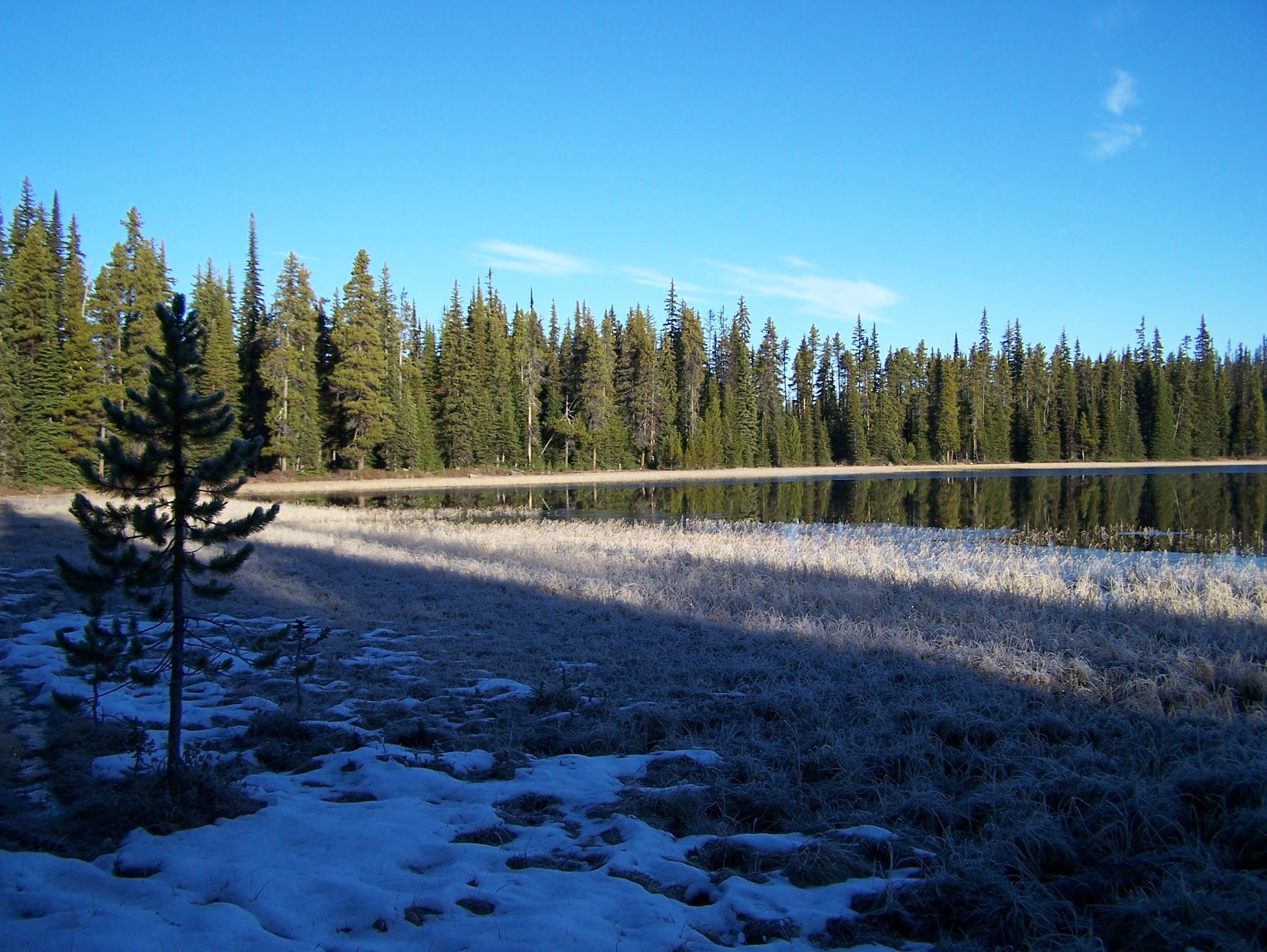
Unfortunately there was a little ice all around the shore and I was unable to really check out the fishing. However I walked all around the shoreline and noticed several tiny streams feeding the lake, which had fine gravely bottoms. Perhaps these would be just enough for a natural spawn. The lake itself is a quiet little gem set in tall timber. The shore is gently sloping grass, so in the warmer weather using a belly boat or wading in with a fly rod could be interesting. If all goes well we will give you an update on fishing here next summer.
 
By eleven it was obvious that the ice would not be off the lake for the day, so I headed back downhill checking out hunting possibilities. This area is not my regular haunt and I wanted to figure out how best to hunt the thicker terrain. I met a fellow cutting wood who has accessed Reed Lake from Howard Lake, but this appears to be the route with the shortest walk.
 
I slowly made my way down to the Ellis Reservoir, tried fishing there for an hour and then headed out on the flats behind. Checking the stocking reports, Ellis Reservoir has been stocked with Pennask lake fry in September the last six years. It looks a lot more inviting for fishing when the dam is full. In the fall, however, there is a lot of muddy shoreline to contend with which does detract from the desire to fish here. Of course, with the lower water the fish just might be concentrated into smaller areas.
 
Not particularly excited by the fish action, I checked the maze of old roads south and west of the dam before heading home. I did see a few grouse and only a few bottles and cans. Yes, there are still a few people who do not respect this beautiful area where we live. There are a couple of places where it might pay to set up a tree stand for deer hunting as there is a good Population of mule and white tail deer in the area.

Note: This was in 2011 and somehow, I have not had the time to get back in to check this out. If anyone has any new information, give me a shout.

Monday, October 15, 2012

Survival Guns


With hunting season upon us, hunters begin to seriously talk about guns. What is the best gun to carry in the bush for survival purposes. We have all heard stories about the hunter who puts his rifle down to clan and elk, only to be surprised by a grizzly, or tales about people getting lost and perishing in the bush.

I must admit although I am comfortable sitting down and watching a bear at close range, I do get a little concerned when I have others along with me. Sitting and eating a sandwich a scant fifteen meters from a black bear while he gorges on raspberries is s pleasant experience when you have your big game rifle along. When a bear charges out of the bush towards you and your son as you hike into a like is a fit more unsettling. Having a good gun along is a handy in case the bear dos not turn aside.

In another instance, my younger brother and I got lost while hunting. Cold, wet and hungry we plodded through the heavy snow, large wet flakes reducing our vision to a few meters. After about an hour we came upon some tracks, which after a while we realized were our own, we had walked in a circle. Fortunately we had managed to get a grouse and stopped, built a fire and ate while collecting our thoughts and bearings.

What makes a good survival gun? You want some knock down power in case of those unexpected encounter with the unpredictable bruins. However being able to get some small game for a fire is also nice.

My first choice would be a pair of pistols, but unfortunately, they are not legal to take into the bush for the purpose of hunting in Canada. (In the several States in the United States hunting with a hand gun is legal) If I could I would carry both a .22 and a .45 calibre  pistol with twenty three centimetre barrels. Shorter barrels greatly decrease the accuracy and so are of little use. Both these guns with a little practice are accurate enough at close range. The lighter .22 calibre would be great for getting a supply of birds and other small animals. The .45 calibre has the close range knock down power for bears and other large dangerous animals.

Having to choose a rifle instead, I would love to have a .22/306 over and under rifle. Carrying it around would be easier than two rifles and it could be used for both small and large game. The largest draw back to this rifle is the high purchase price. One other thing that needs constant vigilance in suing an over and under rifle is ensuring the hammer is on the proper chamber. Using a .306 to bring down a bird would often result in a shower of feathers and no meat. Still I believe it is the easiest and most versatile gun to use in the bush.

Whether the Federal Government will scrap the gun registry remains to be seen. Rather than a gun registry, all that should be required is a permit to use a gun. The current registry does not identify which guns are used in a crime or even if they are registered or not. The only way to accomplish this would be for all registered guns to have ballistic samples takes at the time of registry. An unregistered person using a gun would have to be under the direct supervision of registered, fire arms user. Requireing all guns to have trigger locks on when in storage or during transport to the range or to the hunting area would also serve as a control over usage. A person registered to use firearms would be able to purchase new firearms or to dispose of his or her firearms to another registered gun user.

It is time for the law to protect the responsible firearms users and to get tough on those who use guns for illegal purposes.


Friday, October 5, 2012

Lower Clarke Lake and small waters


Lower Clarke Lake

In the old days, we used to hike into Mclean Clan Lake from Lower Clarke Lake. Lower Clarke Lake is one of those lakes which have a drastic draw-down in the fall. Take the first road to the left once you have passed where the Allendale Lake road crosses the Weyerhaeuser 201 road. It’s fairly easy to spot, just take it easy. You can drive right on to the dam or if you prefer, park well back and walk in so you know the condition of the road.

This lake is stocked quite regularly and when I checked it out, action was reasonably fast. The fish were between 5 and 9 inches, but when you land about 25 in an hour and a half on a light leader and tiny fly with a peacock feather body, as well as getting many more strikes, it is lots of fun . A blue heron gliding down to the shore was a real bonus.

In the fall the shoreline is a mixture of slippery mud, rocks and fallen trees. I used the canoe, but a person could just as well use a belly boat or fish from shore. Shore fishing does limit the coverage of the lake, but with a reasonably heavy float and a light line you should be able to get out where the fish are rising. More adventuresome fishermen might try edging out on some of the trees down at the shore, but be extra careful trying this.  I still have a four-inch scar on my thigh from when some bark peeled off under my foot and I fell, gashing myself on a sharp branch. So much for that fishing expedition.  I hobbled back to the car with my kids in tow while keeping direct pressure on with my free hand .

Little beaver dams can hold a surprising stock of fish both in number and size. Once behind Nickel Plate Lake my cousin and I pulled about 200 fish out of a hole about half the size of a bath tub. Even then the waters still boiled when we set our fly in and we hardly made a dent in the swarm of fish in that little hole. These fish were very thin-bodied and obviously starving. Not all beaver dams produce small fish, as I have landed trout up to about 14 inches in length.

We usually tend to fish near the tangle of trees or weeds along the shore and wish the fish we see rising there would come out in the open water. One way to fish these tangles of trees or weedy bays, is a method call dapping. Dapping is best done with a fairly long stiff rod and a reasonably heavy line. (Note, hard core dappers use poles from 12 to 15 feet in length with short lines attached.) This is because you need to quickly get a fish under control before they wrap around a weed or branch. Keep the line short and use a small weight so that the fly or plug hangs straight down from the tip. Dip the fly down dapping it just into the water and often just holding it above the water between the logs or lily pads.

You will undoubtedly lose a fair amount of tackle, but sitting there quietly and patiently just might land you some bragging size trout. Try dragging a small imitation frog from pad to pad, or try to match the insect life with your flies. Never be afraid to try something new or to try even the smallest bit of open water. I’ve seen trout near 50 centimetres in length in a tiny creek less than a half metre wide.

Thursday, September 27, 2012

Taylor Lake


Taylor Lake
 

It’s been a little while since I had been into Taylor Lake. We used to hunt the Barslow Canyon area and hike over to this lake to have our lunches, and usually caught a mess of nice brook trout even though there were just a few spots to fish from shore.

It can be accessed from the Twin Lakes Golf Course off Highway 3A, from Oliver via Willowbrook or from Penticton in past the Saint Andrews Golf Course. This was the route I had chosen today and was rewarded with the sighting of a cinnamon coloured black bear. Just past White Lake Observatory I met two ladies looking for fossils and spent an enjoyable 20 minutes talking to them. The road then passed the Oliver-Willow Brook Road and traversed the open sage bush country until reaching the Twin Lakes Road.

I zeroed the odometer here and took the left turn for 0.4 kilometres before taking another left onto the Grand Oro Road. The pavement extends most of the through the subdivision before becoming a narrow dirt road. Past the private land and at 5.9 kilometres I took the left hand fork. At 6.4 kilometres a road splits off to the left up to the old Grand Oro Mine site: most of the buildings have been demolished, but there are a few cabins on the other side and the road drops down to Willowbrook. This is a very rough road, however, and should be carefully travelled.

The lower right hand road gets quite rough and the vegetation is much denser, not really great if you are worried about keeping the finish of your vehicle scratch free. There are several old side roads that could easily be missed. The one at 7.9 kilometres circles back and joins up with the Grand Oro Mine Road. At 8.3 kilometres there is one off to the right that takes you out to some good deer and grouse hunting, and if you are lucky you might find the old tree stand.

The next one of note is at 9.8 kilometres. This little road leads up to an old historic cabin: one can only hope that it is preserved. Keeping to the left at 10.7 kilometres will take us to Taylor Lake, while the way straight ahead leads to some open areas overlooking the Fairview Road. This is a good area for mule deer and blue grouse.

The boat launching area is at 11 kilometres, and at 11.1 kilometres there is a nice turn around spot with a fire pit and picnic table. Parking here I took the fishing gear and checked out the lake. I had smelled smoke earlier, and sure enough there was a smouldering fire by the boat launch. Please, take that extra minute and douse your fires. The gusting winds can fan the embers into flames or send sparks for some distance.

Gone were the huge log and rafts that offered a few good spots to fish from the shore. I did manage a few casts, but this is definitely a lake for a canoe or belly boat now. I did see a few nice fish jump and talked to some fishermen on the way out who had landed a few good sized trout.

According to the Fish Wizard web site, the species present are brook trout and rainbow trout. Last year and this year it has been stocked with 500 yearling triploid rainbow trout of the Pennask Lake strain of rainbow trout.

Taylor lake is one of many high mountain lakes that were dammed ages ago without clearing the bush around the shoreline. This has left many dead snags and a weedy shoreline that makes fishing from the shore very difficult, if not impossible. I would recommend a small canoe, boat or belly boat at this lake


Wednesday, August 29, 2012

Madden Lake


Madden Lake

         I had been asked to test some SHOOT N C Targets, and thought I might as well make a quick trip into Madden Lake as well to check things out, before sighting in my twenty -two rifle.

 While it is possible to get to Madden Lake by the Sawmill Lake road off the Fairview-White Lake Road, the easiest way is to continue from this junction 6.9 kilometres up the Fairview Road. Turn left at the sign-post for Ripley and Madden Lakes. At the 7.3 kilometre mark the Ripley Road takes off to the left, soon passing under the power line. At 7.8 kilometres, keep to the left then stay on the main road and ignore all the side roads.

 From here to Madden Lake the terrain is fairly open, largely due to the huge fire that swept through here in 1971. There is an abundance of balsam root and saskatoon bushes all along this route. The balsam root is a good wild edible and at times a favourite for the blue grouse as they go for the seeds in the fall. Bears perhaps covet the saskatoon berries even more than we do, for you often see plenty of evidence of this in bear scat.

 Arriving at the lake, the odometer showed just under 9.4 kilometres. I found the recreation site full to bursting even this early on a Friday afternoon, and new arrivals were turning away to search for other option. There seems to be eight official sites, but several more makeshift ones were also in use. Unfortunately I was told about one of the tables being destroyed and burned the previous week. Subtle use of a cell phone camera would be great if turned in to the police to capture such selfish culprits.

There is a trail around the lake that does access some spots to fish from shore, but a lot of the shoreline is full of bull rushes and  reeds. The most popular method of fishing is by boat and with a fly rod. Chromids appear to be working very well this May long weekend, and I had several reports of fish caught between one and two pounds. Several years ago, I passed this way during hunting season and saw a fellow with six nice fish that appeared to be about four pounds each.

 This whole area between Sawmill Lake and Ripley Lake is criss-crossed with roads and trails that are popular with ATV users and trail bikes. The dryness of the country leaves it very susceptible to damage and I would encourage users to remain on established trails. There seems to be some improvement in the amount of garbage left out in the country, but there is still some evidence of abuse. This is also rangeland, so remember to leave gates as you find them to keep the cattle where they belong.

 My prime purpose today was to test a special target and I did not want to disturb the campers and fishermen. Slipping further uphill I located a quiet spot with a good backstop where I could set the target up in the shade. One shot was all it took to impress me. A brilliant yellow circle appeared just off to the right and below the  florescent bulls eye. Upon impact, part of the black coating around the shot flakes off showing the yellow under undercoating on the target. Even though the target was placed in the shade, this shot showed up on the black three-inch circle very clearly. Three more shots and I already felt I was ready for bird season in the fall. Ask your local sporting goods dealer if they have the Shoot N C target. They are available from Birchwood Laboratories Inc.

Monday, August 20, 2012

Rubber Rafting


Rubber Rafting

Belly boating might be fine when I’m alone, but what if I hike into a lake with a buddy? Maybe a four man rubber raft would be the answer. Fortunately one was on sale, so off I headed to Ripley Lake for an afternoon trial run.

Set up went smoothly and in fifteen minutes the raft was inflated and on the water. I don’t know how big the four men were, but if they were all my size, we’d have to squeeze in and only take small breaths. Will definitely have to take the minimum tackle next time too, it was hard to swing around to search in my normal tackle box.

Rowing went OK with just me in the boat, slow, but OK. I spent the better part of two hours, slowly moving about the lake, trying to get the feel of fly fishing from sitting so low to the water. I wasn’t fabulous, but it would do if the fish were into feeding, which unfortunately they were not.

This did have some advantages over the belly boat, no chest waders required being the first one and I did not lose and fins or oars. The most advantage would be only carting one craft into one of the small lake on my to do list. Still, I do miss a canoe.

Sunday, August 12, 2012

Belly Boating Disasters


Belly Boating Disaster

            What else can I say to describe my first two belly boating outings. Both were at Chute Lake north east of Naramata. My first trip out was a short one. Lesson number one: when trying on foot wear and the chest waders, use the same footwear you will be using while out on the water. My footwear would not go over the waders, so I’ve already a small hole in one of the soles.

            Well, into the water just the same. Only this time I get about 15 meters out and a fin flips off of one foot. Try as I might I could not locate the fin and my first outing was cut short.

            Now with a new pair of fins, I try everything on at home. Everything checks out, so off to Chute Lake I head again. This will surely be better than last week.

            Everything seems to be working fine, I’ve been out on the lake for a couple of hours, but the fishing is slow. Suddenly, I give another kick and groan as another fins slips off my foot and into the depths. Looking down the lake it is time to start limping back to the launching site. I am in no hurry, but after another half hour passes, the second fin comes off and sinks into the lake.

            Slowly now I scull towards the landing site using my hands stopping occasionally to cast. Score now two outings, two fish to the belly boat, one keeper not landed as I did not have a net, three fins at the bottom of the lake.

            Next time I am out belly boating I will have a cord attaching the fins to my ankle. I would also recommend a careful selection of your belly boat. On this particular belly boat one of the air chambers is very difficult to inflate and deflate. It is best if you can see a model displayed so you can check out rod holder and tackle compartments.

            Staggering out of the water with partially filled chest waders also brings home the importance of using a personal floatation device.
            I do miss my canoe

Monday, August 6, 2012

Trout Creek Canyon Trail


Trout Creek Canyon Trail

            The middle of July was hot, so a friend and I made a date to walk this trail early on a week day morning. Gone was the trail I remembered for the early 50’s. (kind of dates me doesn’t it.

            We drove out towards Trout Creek and turned up the hill towards the Summerland Research Station. Almost immediately a small road takes off to the right and into a small parking lot. Here a narrow zigzag opening in the fence led us to the trails. I was so narrow that I was glad I did not have my big pack.

            The first thing I noted was an elderberry bush near the parking lot. Striking out, we followed an old road on top of the creek bank. Every so often a small path would break off and head toward the hill side, which I kept scanning for the trail I remembered. Eventually the trail petered out as the canyon wall closed in. It had been an easy walk through fields of baby’s breath plants and by nearly barren Saskatoon bushes and Oregon grape.

            Heading back we took an old road up to the Research Station fence, stopped for a bite to eat where I took these pictures.  We also noted some signs of an industrial operation from many years ago, which appeared to possibly be a cement plant of some sort. There was also a wooden bench sitting amongst the babys breath. This was crafted together with wooden dowels instead of nail.

            Walking at a leisurely pace and talking we spent an enjoyable hour and a half, but a fast walk could possibly cover this in a half hour.

Tuesday, July 24, 2012

First Deer


First Deer


Just picked up my fishing and hunting licences. Make me remember my first deer all those many years ago. It was a tough year for getting out. My Mother-in-Law was visiting from New Zealand, so I had only spent one afternoon up near Howard Lake.
Now it was the last day of the season and I was checking out the Bald Range between Summerland and Princeton. Six inches of fresh moist snow covered the ground, so it was easy to see where the deer had been active. However, I was hoping to find where they were now.
Since first light I'd be driving from old road to old road and carefully checking them out. Now I was heading down the last one I could check and light was fading fast, only about a half hour of shooting light left as I parked at the log landing at the end of the road. Discouraged, I still slipped out of the subaru and began walking around the clearing a few yards into the trees.
Suddenly two deer bounded out into the centre of the clearing and one was a nice buck. A quick shot from my 30-30 dropped it in its tracks and the doe took off. Just as I got up to the buck it raised its head. Having read about people being severely injured by a wounded animal. I put the rifle to its throat and shot into its brain.
Rapidly I cleaned it as well as I could from all that I remembered that Dad had told me. Then dragged it about 300 yards down to the car and tried to load it into the back. All I could manage though was to get the back end in and it would slip out as I tried to lift the rest. Remembering I had passed a couple of men cutting wood a half mile back, I tied the antlers to the trailer hitch and drove back down the road, hoping they would still be there.

Luck was with me and the three of us managed to lift it up onto the roof rack. I got their name and address so I could repay with a venison steak. Now in the gathering dark I drove back home. One hand held the sagging roof and the other on the wheel. This first deer is still the largest deer I have ever taken and we ended up with 165 pounds of venison in the freezer and enjoyed roasts again for the first time in years.

A friend who was an avid hunter, came and helped me finish dressing it out and hanging it before we later skinned it out and took it to the butcher shop. To his surprise he could not find a hole in the body. If you enlarge the picture and look carefully you just might see where I hit the buck.

Tuesday, July 17, 2012


Yellow Lake
                                                          
            Yellow Lake lies along highway 3A between Kaleden and Olalla, just beyond the Twin Lakes golf course. This was basically a barren lake until the late “60’s” when an enterprising young fisheries biologist suggested an aeration system. This has been a tremendous success that it is a wonder more of our little mountain gems have not been converted to this system.
            The lake is liberally stocked annually, much to the delight of both ice fishermen and the summer anglers. Half the shoreline is easily fished by the land locked angler, and a boat launch at the Keremeos end provides an easy access for smaller boats, belly boats and kayaks. There is ample parking at either end with bathrooms facilities. Again the Olalla/Keremeos end has the best facility with running water and heat.
            I finally had a few hours the other day so zipped out to wet the first line on the season. It was a cloudy and cool day, but still reasonably pleasant and in a half hour I had hooked on to a couple of small fish.
            The message seems to be slowly getting through, but I was still disappointed with the amount of litter along shore shores and edges of the water. Have a good summer on the lakes and keep packing out what you pack in.

Wednesday, July 11, 2012


Oregon Grape

            Not all edible plants are all that palatable to all palates raw. Oregon grape is on of those which would definitely be an acquired taste raw. It does however make a superb jelly.

            This low to fairly tall bush, has prickly evergreen leaves resembling a holly tree. In the spring it has clusters of yellow flowers which produce clusters of deep bluish berries. Very rich in pectin, it does not require pectin in order to jell.

            It is wide spread in British Columbia, from valley bottoms to around 1,300 meters. Depending on weather and elevations berries can begin ripening in July and carry right on until the fall frosts. The riper the berries the more pectin.

We found that about half an ice-cream pail was sufficient for a batch of jelly. In a large sauce pan mush the berries and add a cup of water and heat until the juice is running freely. Strain the liquid out and add 1-1/2 cups of sugar for each cup of juice and all a ½ cup of lemon juice. Boil until it begins to set, skim, and then pour into sterile jars and seal immediately.

At first I seemed to have a bit of a reaction to the jelly, but it tastes so well I persevered and can now eat it with no problem.

Wednesday, May 23, 2012


Puffballs

            Puffballs, most people are reasonably familiar with them and they have had a lot of bad press. Apparently they were not well received by the First Nations Peoples as well. In fact when I was young I hear stories that the mature puffballs releasing their spore could cause blindness.

            Fortunately I was invited to try some puffball steaks sautéed in butter. Once eaten I was  hooked on this delicious morsel. In face it is in second place as my all time favorite mushroom. Most are relatively small and must be picked while they are still immature, white though out the solid flesh. Usually the size is between the size of a golf ball and a tennis ball. Once however I spotted one that was nearly dinner plate size in diameter.

            My mouth was drooling over the thought of rushing home with it and quickly putting it in the frying pan. Unfortunately the inner core had already begun to mature and was slightly yellow in the centre. With heavy heart I set it back down.

            Puffball season is right from the early spring and into the fall. I highly recommend anyone interested in gathering wild mushrooms to get a good mushroom guide book. One afternoon while out with the family and mother-in-law from New Zealand we collected just under 90 different mushrooms. The task of identifying them before they went off was just too great, but it did really spark my interest.

            The picture above was taken just behind our yard, the puffball a little larger than a golf ball. I should have picked it the evening before, but I was hoping to make a nice mushroom omelet.

Wednesday, May 16, 2012


Rice root (Chocolate Lily)


Rice root bulbs

Rice Root


     Rice root is also known as Indian rice or Chocolate lily. It has a central bulb surrounded by many small bulbs similar in appearance to white rice. Cleaning these tiny bulblets in preparation for boiling is very time consuming, but once in a while for a treat it is worth it. I find the taste and texture a cross between potatoes and rice.
   The plant itself is a perennial, standing anywhere between about 1 foot to 2 foot in height. The flower is bell shaped and nodding, dark brown to dark purple with green to yellowish spots. The odor is a bit like rotting meat. The stems are slender and the whorls of leave tapering.
     Distribution is in meadow or grassy areas from sea level to alpine regions, This particular one is found in the Okanagan, Similkameen , down through th lower Fraser Valley and one to the islands. There is a similar one in the central interior and the northern coastal regions, but I am not familiar with it.
     Before picking some for a treat, look around and make sure the crop can stand a little harvest. Enjoy.

Tuesday, May 8, 2012

Yellowbells


Yellowbell


Ah!  Spring  is in the air and I can not help but think of wild edibles. The yellowbell while not as plentiful as the spring beauty is a particular favorite of mine. It is a perennial usually about 8 to 10 inches tall with a few long slender leaves at the base of the stem. The yellow bell nodding gracefully on the slender stem. The bulbs can be up to a 1-1/2 inches long in several cloves and surrounded by small bulblets. These bulblets are usually what I find. These have a pleasant nutty flavor and are great eaten alone or in a salad.


These are found in the dry grasslands in the Okanagan and Similkameen Valleys. Blossoming time is usually from April to May, but at a higher elevation and cooler temperatures may be found into June. Moderation is the key when harvesting this tasty morsel as with any wild crop. If abundant it could be dried, although I personally prefer them raw or lightly boiled

Thursday, April 26, 2012

Wild Aparagus


Wild Asparagus
 

Each year I look forward to the April showers. Good moisture content in the soils means a good crop of spring edibles. Something makes the wild foods you pick yourself seem so much tastier than the store brought varieties. Well for the most part any way. We will in the future talk about some survival foods that do take some getting used to.

Asparagus, while apparently not a native plant (at least not mentioned in books on edible plants of the Native North American Peoples), has spread into the hills and trails in some areas of British Columbia. The dikes and old railway beds of the Okanagan and Similkameen are good examples of their spreading range.

Now that we’ve had the moisture the warm spring days will soon see them sprouting. Generally the time span is from the middle of April until well into June, all dependent on the weather of course. With this wild edible as with all wild edibles care must be taken not to pick the crop too heavily. I’m always happy to see some plants left to frond out and go to seed. It is the seed that unexpected joy of suddenly finding a hidden patch which no one else has yet discovered.

I like the asparagus gentle steamed, just enough so that it retains a hint of crispness. The butt ends I chop into small pieces and boil briefly in boiling water before adding cream of mushroom soup for a quick cream of asparagus soup.

Welcome to my new reader in China. I hope you enjoy these glimpses into the life styles of a slightly elder mountain man.  Let me know which ones you enjoy the most and I’ll do more like them if I am able.

Tuesday, March 27, 2012

Cathedral Park - Part 2


Cathedral Park - Part 2

Pictures to follow. Just got a new scanner which I hope will be up and running in a few weeks.

So far we’ve just handled the easy trails in the Cathedral Parks core area. The more challenging Rim Trail uses the Ladyslipper Trail and then heads up the scree to the rim that circles the lakes before dropping down at the western end to link up with the Diamond Trail and back to the lodge.

One can also cut the circuit short by dropping steeply down the Glacier Trail past Glacier Lake, or taking the trail down to Quiniscoe Lake. We took the Glacier Trail down and the ladies were very glad to get back to the cabin, some good wine and a great dinner.

Much of this terrain is over broken ground and boulders, particularly, it seemed, on the north-western end near Red Mountain and the Quiniscoe Trails. Good boots and hiking poles are highly recommended, especially for less experience hikers.

Turning left at the top of the Ladyslipper Trail takes one to Smokey The Bear, Giant Cleft, Grimface Mountain and Macabre Mountain, all good spots for mountain or rock climbing.

The Lakeview Mountain Trail is 12 km with a 600 metre elevation change to the top of Lakeview Mountain at 2628 metres. Past this point the hiking is more difficult and unmarked, but it is possible to hike past Boxcar Mountain and Haystack Mountain to the Haystack Lakes, where there is a wilderness walk in camp. How I long to do that one! I imagine the fishing would be fantastic.

Permits must be obtained in order to ride horses into the park, but it just might be the ticket in getting to spots like the Haystack Lakes. There is no charge, just written permission required(unless I‘m mistaken).

Check with the lodge for accommodation rates and fees and schedules for jeep rides up to the lodge. If you are planning on wilderness camping the fee for 2009 is $5.00 per day per person. You are also advised to take along a camp-stove as fire pits are not always available.

Serious backpackers might want to hike up from the valley bottom. The Ewart Creek trail is reached by crossing a bridge about 6 km up the Ashnola Forest Service road onto the Ewart Creek Road. There are a few private residences here, but carry on to the trail head about 3 km further along, where the Ewart Creek joins the Ashnola River. The trail to the lodge is 28 km and the elevation change is 1730 metres. The first part of this trail is used by those taking horses into the Snowy Mountain Protected area. While the trip could be completed to the lodge in a day, there is a wilderness campground at the Twin Buttes area.

The shortest route is up the Lakeview Trail at only 16 km and an elevation change of 1300 metres. The trailhead is 13 km up the Ashnola Forest Service Road and crosses the jeep road into the park.

Further up the Ashnola at km 38 on the Ashnola Forest Service road, is where the Wall Creek Trail to the park core can be found as a footbridge crosses the river near the camping area. I have not taken this route -- it is apparently over 40 km of scenic hiking, recommended time two days for a round trip.

Take your camera along as there is lots of wildlife to view, from ptarmigan to mountain goat, deer and bighorn sheep. Ptarmigan can be spotted particularly on Lakeview Mountain and the mountain sheep on the Rim Trail.

Hunting and discharge of guns in not permitted in the core area of the park, so check the hunting regulations closely if you are hunting the Ashnola area.

Happy hiking.

Tuesday, March 20, 2012

Cathedral Lakes Park


Cathedral Lakes Park - Part 1

Will add pictures when I get the printer/scanner working

Our first trip into the Cathedral Park was many years ago when our children were in elementary school. We thought we would walk up to the lodge and get a taste of the alpine scenery. We might have made it to the lodge if we started early enough, but time caused us to turn around before we reached the lodge or alpine scenery.

Lesson learned: if you plan on walking up, start very early in the day and if possible make it a back packing trip of a few days to really enjoy it. The alternative we took many years later with some friends: take the park transport to the lodge and spend a pleasant day or two hiking and generally enjoying the area. Main access is from the base camp about 24 km. up the Ashnola River Road,, different sources quote this trail between 15 km and 29 km. I think it is closer to 15 km.

If you are an avid fisherman, think about packing in a belly-boat. You will likely regret it if you don’t because the lake look so inviting. Also, do not forget your camera and make sure you either have tons of film, or have downloaded your digital before starting the trip.

The lodge and facilities are at Quiniscoe Lake and all trails branch out from here. A few hikes are short enough to enjoy before catching an evening ride back down to the valley floor or before retiring for the night at one of the lodge accommodations or one of the campgrounds. I highly recommend packing in a light backpacking fishing outfit to try one of the many lakes that are in relatively easy walking distance.

The Quiniscoe Lake Trail around the lake is about 2 km, so is easily completed in under an hour and passes a nice waterfall.

Lake of the Woods in a short 1 km walk, and has wilderness camping sites. The trail continues and does a loop, taking you by Pyramid Lake. Elevation change is a slight 30 metres and the trail has been improved with bridges and crowned walkways to stay drier. Allow about 30 minutes to either lake from the lodge or about an hour and a half for the circuit, which is just over 2 km.

The Glacier Lake Trial is roughly 3 km in length and reasonably steep in sections, with an elevation change of about 200 metres. The trail does also continue up onto the rim trail.

I would allow about 3 to 4 hours for a return trip hike to Ladyslipper Lake as it is approx 7 km. The trail winds through mostly spruce with some larch trees, and arriving at the lake you have some spectacular views. A few casts with a fly brought a nice trout rising out of the crystal clear water to strike.

The Diamond Trail, at only 10 km, can easily be hiked in the afternoon before supper. It circles Scout Mountain and the lake with a moderate elevation change of about 240 metres. I remember lots of beautiful flowers in our August trip as I tapered training for my first Ironman event.

The Scout Lake route is fairly short and easily accomplished in less than two hours. It is about 3 kilometres in length over easy terrain just bordering true alpine country. Again as in all the trails I loved the flowers and vegetation.

Goat Lake Trail at 10 km is the furthest lake that one should try for in a day hike. This trail branches off the Ladyslipper Lake Trail and follows the outlet creek from Goat Lake. Total elevation change is not too great, around 150 metres.

More on the Cathedrals and its trails next week.